|
Disclaimer: The views and opinions expressed in these articles are those of the authors and do not necessarily reflect the official policy or position of puroresu.com or its related websites.
THE GREATEST WRESTLER OF ALL TIME
RINGMASTER
NORFOLK'S LOU THESZ IS AS SWEET AS AN ANGEL, BUT IN FIVE SECONDS FLAT, HE
COULD STILL SNAP YOUR LEG BONE
THE VIRGINIAN-PILOT, Wednesday, July 27, 1994
Lou Thesz is a 78-year-old gentleman who sips imported coffee in the morning while surrounded by a collection of antique valuables gathered from around the world.
But he's capable of snapping your leg bone in about five seconds flat.
Soft-spoken with old-world manners and considerable charm, Thesz lives a quiet life in retirement, raising tomatoes on his bayfront condominium deck, which offers a sweeping view of the Chesapeake Bay.
Few of the neighbors who pass his place on East Ocean View Avenue in Ocean View would be surprised to learn that the extremely fit man watering the tomato plants is 78. His strong arms and flat stomach are those of a man in his 50s.
They would be even more surprised to know that Lou Thesz is the greatest wrestler of this century and, in the opinion of many, the finest who ever lived.
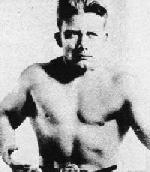
Lou Thesz was a professional wrestler in the classic tradition. Rewind the cassette of time until it spins back to the year 1937, a time when wrestling was real. The scene is Kiel Auditorium in St. Louis with a rectangle of white canvas surrounded by ropes and a howling crowd of 10,500 wrestling fans.
A 20-year-old local boy named Lou Thesz steps into the ring with Everett Marshall, the professional heavyweight wrestling champion of the world. Thesz is known in Missouri, but that's about all. But in his corner is his mentor, George Tragos, an Olympic medal winner.
As the match wears on, the crowd noise builds in intensity as Thesz and Marshall grapple on the mat, neither gaining an advantage.
``My strategy was to just stay even and tire him out,'' Lou recalls. And it worked. Midway through the match, Marshall, standing, brushes sweat from his forehead with a fist and turns to the referee. ``This kid is in pretty good condition,'' the champion says.
To which the referee replies with a stone-face: ``You ain't seen nothin' yet,'' as he shuffles away. Minutes later, Thesz, barely winded, tosses the champion out of the ring. Marshall never returns.
At age 20, Thesz became world champion.
``The crowd just went wild,'' Thesz recalls.
It was merely the beginning. The world had never seen anything like Lou Thesz. An icon in Japan, where he is treated like royalty, Thesz is not widely known even to the fitness freaks with whom he rubs shoulders at the Ghent Athletic Center in Norfolk, although a photo of him in his prime hangs near the door.
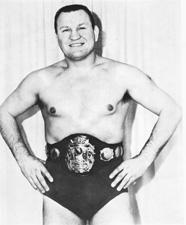
But consider this. Thesz held the world professional wrestling championship for 13 years - longer than any man in history. He regained the title six times. He was the youngest ever to wear the pro championship belt. And he was the oldest to hold the world championship, losing it - at age 64! - to Gene Kiniski, the Canadian football star and pro wrestler.
Small wonder that Culture House has just produced a 60-minute videotape of the wrestling immortal: ``An American Icon: The Lou Thesz Story.''
In the videotape, wrestling fans can relive wrestling history as Thesz gives his opinion - invariably fair and gracious - about heavyweight champions from the past, from Ed ``Strangler'' Lewis to Bruno Sammartino.
So what, you ask. Don't wrestlers come and go? It's just showmanship, isn't it? Maybe today. Not in Thesz's time. He is part of a tradition that goes back to the pancratium in the ancient Olympic games. The pancratium was a much more savage form of wrestling in which hitting, kicking, twisting of the limbs, strangling and struggling on the ground were allowed.
Thesz has never been a performer. He has always been a wrestler, not a wrassler. He calls the professional wrestling seen by millions on television today ``theatrical acrobatics.'' He describes Hulk Hogan, whom Thesz would have pinned in three minutes in the old days, as a great entertainer. ``I'd give him a 10 for body. And a one for wrestling . . . maybe a zero,'' he said.
When you visit the home of Lou Thesz and his wife, Charlie, your eye is drawn immediately to a marble sculpture of two wrestlers engaged in Greco-Roman style wrestling.
It is not for sale because of the connection the retired champion feels with that tradition.
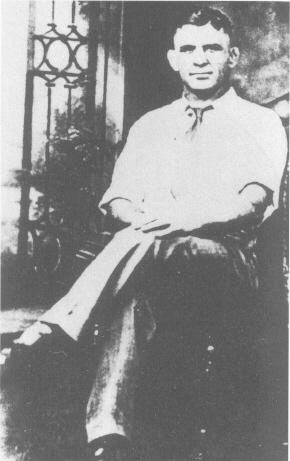
Thesz was born in St. Louis, where his father - an amateur Greco-Roman wrestler in his native Hungary - ran a shoe shop. He came up during the Depression, when a dollar was hard to come by. His dad taught him how to wrestle when he was 8, starting with neck-strengthening exercises.
``I had to bow my back and do repetitions with only my head and feet touching the floor,'' he recalls.
He quit school before reaching high school to wrestle. When he wasn't wrestling, he was in a gym somewhere pumping iron, doing calisthenics, working out on the parallel bars.
``I had friends who were wrestlers, and we'd enter matches around the United States. I remember we'd drive hundreds of miles to wrestle. . . . I remember how hard the times were. Sometimes going to a match we'd jump a fence in a farmer's field and steal fodder . . . not eating corn but fodder . . . and we were glad to get it. Sometimes we'd only get three bucks for a wrestling match.''
He was on easy street after winning the world championship. For about 30 years, he averaged more than $150,000 a year. Once he took a room at a St. Moritz hotel because he fell in love with skiing. ``I was wrestling contenders from all over Europe and skiing in my spare time,'' he said.
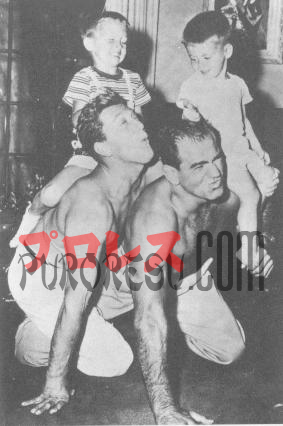
Through the years, he became pals with the sports heroes of his era and quite a few entertainers, including Kirk Douglas and Bob Hope. He has the inscribed photos to prove it. The memorabilia share a room with the world championship belt they gave him when he retired.
Lou Thesz left the sport with unmatched accomplishments. Among them was a reputation as a good guy and a helluva competitor. He was also a hooker, by his own admission.
Hooking is a brutal technique that aims at disabling an opponent by tearing a tendon or breaking a bone.
``I had to do it,'' he said. ``When I was defending my championship overseas, I'd be facing judges who were going to give the match to my local opponent no matter how much better I was. I simply had to have something in my back pocket I could rely on. Everyone did it. I'm not proud of it, and I only did it if it was the only way to win . . . break an ankle or separate the shoulder tendon with a double wrist lock.''
He stared out the picture window with the panoramic view of sailboats skimming the bay, sipping the imported coffee.
``Lovely, isn't it?'' he asked.
Thesz insisted on walking with me through the rain to my car. He said he works out almost daily at the athletic center in Ghent. ``I try to give myself only 60 seconds between sets in the weight room,'' he said. ``I don't think an old man should lift anything in excess of 200 pounds, so I limit myself to that weight.''
I only had one more question . . . ``Uh, Mr. Thesz . . . could you still break someone's ankle today if you chose?''
The old man's smile was as sweet as an angel's.
``Oh yes,'' he replied softly. ``I could do it in a heartbeat.''
And he could, you know.
|